
Consider Scalability When Selecting a WCM Tool
Notions of "scale" in digital are always tricky, but still often important. At RSG we tend to examine technology in terms of scenario fit and strategic considerations, certain filtering attributes can also matter. One key attribute for Web Content & Experience Management (WCM) technology is sheer size of the digital environment.
We decided to address this head-on in RSG's "RealQuadrant" shortlist builder and vendor comparison tool for WCM vendors. Previously, RealQuadrant could deliver results that, while accurate from a functional fit, included vendors who in real life would prove simply too big or too small for your enterprise needs.
So we added a new (optional) question to the upfront filtering for WCM. Here's a screen.
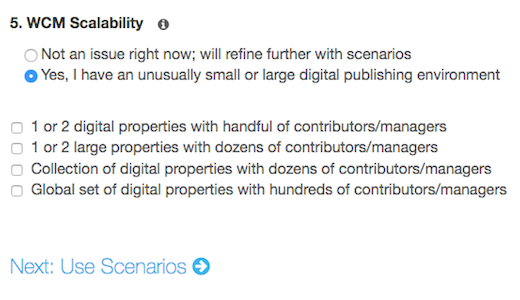
Note that we don't make value judgements about what vendors can and can't support. There's a place for simpler as well as more complex tools in any market. This new criterion helps ensure that you don't waste your time on super high-end tools for smaller WCM operations just as much as it filters out the lower-end tools for truly large operations.
Also, there's more to scalability than size. Fortunately, the WCM scenario choices in RealQuadrant allow you to further filter and match against the complexity and breadth of your specific environments. (You can also weight scenarios, to find even closer vendor matches.)
Try it out and let me know what you think!