
Should you buy Social Software from your ECM vendor?
One of the questions at a "town hall" debate I facilitated at last month's Enterprise 2.0 conference addressed the topic of information lifecycle management for enterprise social spaces. Most of the attendees didn't seem to think it was necessary. I disagree. All information -- be it official enterprise documents or social content -- follows lifecycles, and you shouldn't just publish-and-forget, on your intranet or any public website.
This same lifecycle mantra is promoted heavily by enterprise content management (ECM) vendors looking to get into the social computing game. But does that mean you should buy Social Software from your ECM vendor? I have my doubts. The end-goal is effective networking and collaboration, so any tools you acquire should still be measured foremost by that yardstick.
This issue rose to the fore at the E2.0 conference, where I saw brief demos of forthcoming Social Software products from ECM vendors Open Text and EMC|Documentum. Disclaimer: I only saw demos, and we'll reserve final analysis until after we can talk to customers deploying shipping software.
Open Text Social Media
Open Text was demonstrating a new product called "Social Media," still in beta, due out later this quarter. It's an internal project, led by a team within its collaboration group, but Social Media is not built off Open Text's old collab platform. In fact, it really just provides social networking, with collaboration services promised for later editions. To that extent, it felt a little thin on features. Open Text was promoting a very new -- I thought rather cosmic -- user interface (see this screenshot from Sandy Kemsley). They built the UI entirely off AJAX, which impressed me, and supposedly optimized it for speed, which if true, would be something of a differentiator in this space.
But Open Text is really touting its "candy and aspirin" approach: sweet social with an analgesic back-end. Thing is, I saw no evidence of any aspirin. In fact, I found nothing "Open Text" about it at all. For example, it does not natively use LiveLink as its repository. Social Media has its own, proprietary repository -- from which you can move or copy items to LiveLink -- exactly the same thing you can do with SharePoint libraries. I did not see any native lifecycle management tools, nor any sign of other Open Text services in which you may have already invested. It even has its own, new search engine, to add to the three others that Open Text already supports. Social Media is built in C as a free-standing server. The company says that's for speed (again, a good thing), but the architecture still feels like a one-off system.
Maybe there's more there I didn't see. Open Text can comment if so. And again, it's early days for this beta platform.
Documentum CenterStage
As an aging but venerable ECM player, Documentum is taking a bit longer to come to market. Its "CenterStage" offering remains in customer testing, and not due out for general release until later this year. But it's been a long time coming and has generated a lot of buzz in the Documentum community.
CenterStage is really a kind of hybrid: partly a new interface paradigm for multiple Documentum products, and partly a more social replacement for the company's eRoom collaboration product. CenterStage offers wikis, teamspaces, and the like, but the real "candy" here is its all-Flex rich interface. I've criticized this approach before, but unlike Documentum's Flex-based WCM client, you can actually configure the CenterStage UI via XML files. That's good, though I still don't like Flex for multifaceted enterprise applications. I'm a browser bigot. Standards and all that. But again I'll withhold further judgment until CenterStage sees real combat conditions.
On the plus side, CenterStage's various services all seem to be built off Documentum's core Content Server repository. In theory, this allows you to leverage a variety of repository services, but as always, you need to assess closely what's bound to the repository and what requires separate application services (i.e., more licenses and products). You'll want to test carefully. Still, Documentum's approach seems promising, if you're not in a hurry.
The Marketplace
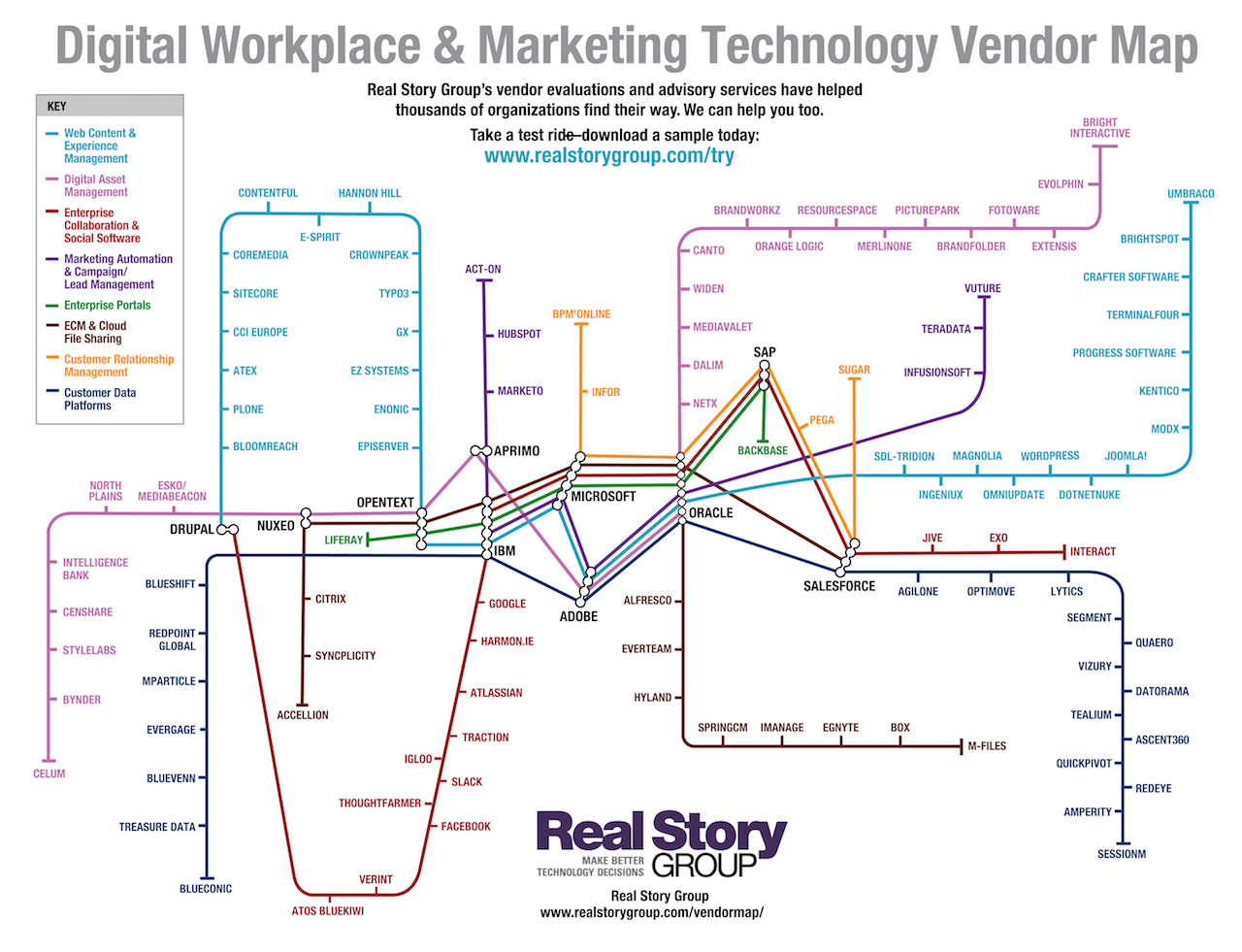
Other major ECM vendors have brought Social Software products to market, but our research suggests they're not faring particularly well either. Let's review them: Oracle (thin, fragmented), Microsoft (missed the boat with SharePoint 2007, conflicted about SharePoint 2010), and IBM (nice start by re-purposing internal applications in Lotus Connections, but slow-footed and diffused since then).
You can get functionally much stronger tools from pure-play Social Software vendors, but at the cost of missing out almost completely on any information lifecycle services. Customers presently seem to prefer it that way. In a world where user adoption is king, I recognize the thinking: fire at everything, and let your search engine sort it out later. At some future point, perhaps when you go to delete an old discussion thread, you are going to have to make some real management decisions.
In the meantime, the Social Software marketplace has reached an interesting phase from an evolutionary standpoint. Some very large dinosaurs are lumbering around. You'll find a plethora of small, fragile, but adaptable mammals flitting successfully among them. Today, I think the mammals are winning. Tomorrow, meteors could strike. We'll keep watching. If you're looking for the inside story on individual solutions, please check out our evaluations.